How to Use Lab Results for a Nutrition Plan: A Root-Cause Guide
Your lab report is not a verdict. It is data. Here's how to use lab results, symptoms, lifestyle, and food choices to build a nutrition plan that actually supports your body.
Written By Admin
Published On JULY 29, 2026
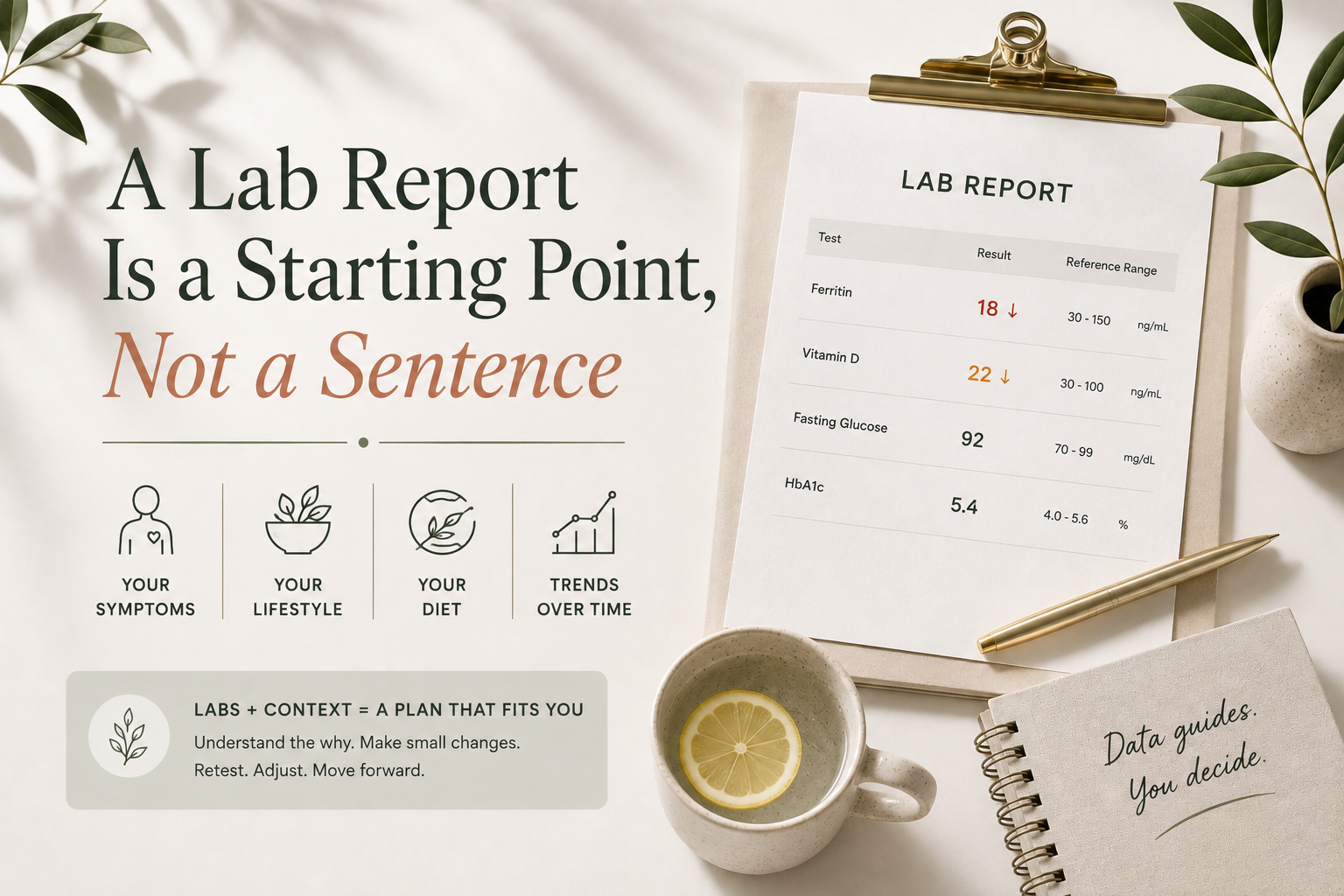
A Lab Report Is a Starting Point, Not a Sentence
There's a particular kind of anxiety that comes with opening a patient portal and seeing a number highlighted in red or yellow. It's easy to read a flagged result as a verdict on your health, something fixed and alarming that needs to be fought against. In reality, a lab report is simply a snapshot of your body's chemistry on one particular morning, influenced by sleep, stress, hydration, recent meals, and the menstrual cycle, among other things. Used well, it's one of the most useful tools available for building a nutrition plan that actually fits your body. Used poorly, it becomes a source of panic that leads to unnecessary restriction.
Why Numbers Alone Rarely Tell the Full Story
A single result sitting outside the reference range doesn't automatically mean something is wrong, and a result sitting comfortably inside the range doesn't automatically mean everything is fine. Reference ranges are built from population averages, not from what's optimal for any one individual, and many labs, ferritin and vitamin D among them, have a wide gap between what counts as merely 'normal' and what actually supports how a person feels day to day. This is why the most useful nutrition plans are built from labs plus context, not labs in isolation.
The Four Pieces of Context That Turn Labs Into a Real Plan
Symptoms
Fatigue, hair thinning, mood changes, digestive issues, and sleep quality are all real data points, even though they don't show up on a lab report. A slightly low-normal ferritin paired with noticeable fatigue and hair shedding tells a very different story than the same number in someone with no symptoms at all. Symptoms give the numbers meaning.
Lifestyle Factors
Sleep patterns, stress levels, activity, and even recent illness all shift lab values temporarily. A cortisol or blood sugar reading taken during an unusually stressful week isn't necessarily representative of a person's baseline, and factoring in what was actually happening in someone's life around the time of testing prevents overreacting to a number that may simply reflect a rough patch.
Current Diet
Lab results only make sense in the context of what's already being eaten. Low iron in someone eating iron-rich foods regularly points toward an absorption issue worth investigating further, while low iron in someone eating very little of these foods points toward a more straightforward dietary gap. The same lab result can call for two entirely different plans depending on what's already on the plate.
Trends Over Time
A single lab result is a photograph; repeated labs over months or years are a video. A vitamin D level that has been slowly declining across three consecutive tests tells a different story than the same single number seen in isolation, and tracking values over time is one of the most underused tools in personalizing nutrition.
Common Labs and What They Can Reasonably Inform
Ferritin can inform decisions around iron-rich foods and pairing them with vitamin C for better absorption. Fasting glucose and HbA1c can inform how meals are structured around protein, fiber, and carbohydrate timing. Vitamin D can inform both dietary sources and time spent outdoors. Lipid panels can inform the balance of fiber, healthy fats, and refined carbohydrates in a diet. None of these labs demand a rigid, one-size-fits-all protocol; they simply narrow down which areas of the diet are worth paying closer attention to first.
Building the Plan: A Practical Sequence
Step One: List What's Actually Flagged, and by How Much
A value just barely outside the reference range deserves a different level of attention than one significantly outside it. Separating minor deviations from more meaningful ones prevents a nutrition plan from trying to overhaul everything at once.
Step Two: Match Each Flagged Value to a Symptom, If One Exists
Cross-referencing lab flags with actual, lived symptoms helps prioritize which nutritional changes are likely to make a noticeable difference versus which are more precautionary.
Step Three: Identify the Smallest Dietary Change With the Largest Likely Impact
Rather than overhauling an entire diet at once, identifying one or two specific, targeted changes, such as adding a vitamin C source alongside iron-rich meals, or shifting breakfast to include more protein for blood sugar stability, tends to be both more sustainable and easier to evaluate for effectiveness.
Step Four: Retest With Intention
Rather than guessing whether a change worked, retesting the specific value in question after a reasonable interval, typically two to three months for most nutrients, turns the entire process into a feedback loop rather than a one-time guess.
When to Involve a Professional
Significantly abnormal results, results that don't improve despite reasonable dietary changes, or labs suggesting a condition that needs clinical management, such as marked insulin resistance or a thyroid abnormality, are all situations where a doctor or registered dietitian should be part of interpreting the full picture rather than adjusting a diet in isolation.
The Bottom Line
A lab report becomes genuinely useful the moment it's treated as one input among several, rather than a verdict to be feared or a rulebook to be followed rigidly. Paired with real symptoms, an honest look at current diet and lifestyle, and a willingness to retest and adjust over time, lab results turn from a source of anxiety into one of the more precise tools available for building a nutrition plan that's actually built around your body, not around a population average.
Frequently Asked Questions
Should I make dietary changes based on a single lab result?
A single result is useful information, but it's more reliable when considered alongside symptoms, current diet, and, where possible, a trend across more than one test.
How often should labs be retested after a diet change?
For most nutrients affected by diet, such as iron or vitamin D, retesting after two to three months gives a reasonable window to assess whether a change is working.
Is it normal for lab values to be borderline without being flagged?
Yes. Many labs have reference ranges wide enough that a value can sit at the lower or upper edge without being flagged, even though it may still be worth paying attention to if symptoms are present.