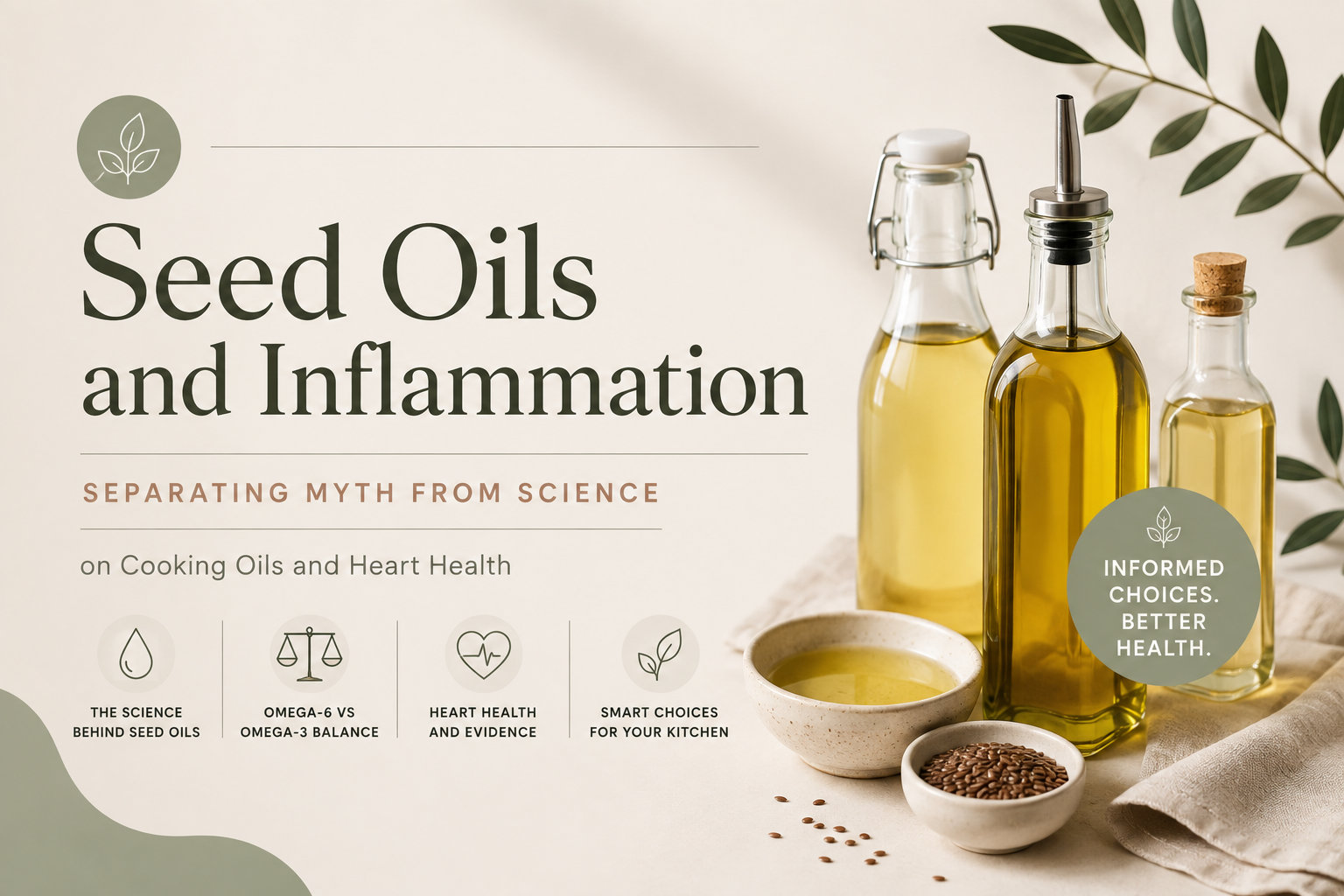
Seed Oils and Inflammation: Separating Myth From Science on Cooking Oils and Heart Health
Seed oils have become one of the most debated topics in nutrition. Here is what the science actually says about inflammation, omega-6 balance, heart health, and which cooking oils to choose.
Written By Admin
Published On JULY 29, 2026
Seed Oils and Inflammation: Separating Myth From Science on Cooking Oils and Heart Health
Few topics in nutrition have become as polarising in recent years as seed oils. On one side, entire corners of social media insist that sunflower, canola, and soybean oil are quietly poisoning the food supply, driving chronic inflammation and disease. On the other side, mainstream nutrition bodies continue to recommend these same oils as heart-healthy alternatives to saturated fat.
Both camps can't be entirely right, and the truth, as usual, sits somewhere more nuanced than either extreme is willing to admit. Understanding what seed oils actually are, what the research genuinely shows, and where the real concerns lie can help you make an informed decision in your own kitchen, rather than reacting purely to whichever version of the debate you encountered most recently.
What Exactly Are Seed Oils?
Seed oils are vegetable oils extracted from the seeds of plants rather than from fruit, as is the case with olive or avocado oil. Common seed oils include sunflower, canola, soybean, corn, grapeseed, and cottonseed oil, most of which became widely available in the twentieth century as industrial extraction methods made them cheap to produce at scale.
These oils are typically high in polyunsaturated fats, specifically omega-6 fatty acids, which is where much of the current debate actually centres. Omega-6 fats aren't inherently harmful, in fact they're essential fatty acids your body can't produce on its own, but the conversation becomes more complicated when you look at how much omega-6 the average modern diet contains relative to omega-3.
The Omega-6 to Omega-3 Ratio: Where the Real Concern Lies
Both omega-6 and omega-3 fatty acids are essential, meaning your body needs them from food, but they play somewhat different roles, particularly around inflammation. Omega-6 fats can be converted into compounds that promote inflammation, while omega-3 fats tend to support anti-inflammatory pathways. A healthy body needs both, but balance between the two appears to matter.
Historically, human diets contained omega-6 and omega-3 fats in a ratio somewhere close to one-to-one or four-to-one. The modern diet, heavy in seed oils and processed foods, has shifted this ratio dramatically, with some estimates suggesting ratios as high as fifteen-to-one or even twenty-to-one in favour of omega-6. This imbalance, rather than seed oils in isolation, is what many researchers point to as the more likely contributor to low-grade inflammation, rather than seed oils being uniquely toxic on their own.
What the Research Actually Shows About Seed Oils and Inflammation
Despite the intensity of the online debate, the research picture is more mixed and more nuanced than either extreme suggests. Several controlled studies have found that replacing saturated fat with polyunsaturated fats, including seed oils, is associated with modest reductions in LDL cholesterol and cardiovascular risk markers, which is part of why mainstream health bodies continue to recommend them over saturated fats specifically.
At the same time, some researchers argue that these studies don't fully capture the effects of long-term, high omega-6 intake on chronic low-grade inflammation, particularly in the context of a diet already skewed away from omega-3 sources. The honest answer is that the research doesn't support the dramatic "seed oils are toxic" claims circulating online, but it also doesn't offer a completely clean bill of health, particularly for how these oils are used in ultra-processed food manufacturing and repeated deep frying.
The Real Problem May Be Processing, Not the Oil Itself
One of the more reasonable positions in this debate focuses less on seed oils as an ingredient and more on how they're typically used. Seed oils are cheap and heat-stable, which makes them the backbone of most fried and ultra-processed foods, from packaged snacks to fast food fryers reused for days at a time.
Repeated heating, particularly at high temperatures used in deep frying, can cause seed oils to oxidise and form compounds that are genuinely associated with inflammation and oxidative stress. This suggests the concern may have less to do with a tablespoon of sunflower oil in a home-cooked stir-fry, and considerably more to do with the volume of deep-fried and ultra-processed food most people consume, where seed oils happen to be the primary fat used.
Should You Avoid Seed Oils Entirely?
For most people eating a reasonably balanced, whole-food diet, occasional use of seed oils in home cooking is unlikely to be a significant concern on its own. The bigger, more actionable opportunity lies in reducing overall intake of ultra-processed and deep-fried foods, which naturally reduces seed oil exposure as a side effect, while also reducing exposure to refined sugar, sodium, and other less favourable additives found in the same foods.
For those wanting to be more deliberate, shifting the balance of fats in the diet toward more omega-3-rich sources, and choosing less-refined, cold-pressed oils where practical, addresses the underlying ratio concern more directly than eliminating seed oils outright out of fear.
Better Cooking Oil Choices for Different Uses
For High-Heat Cooking
Refined avocado oil and ghee both have high smoke points and relatively stable fat profiles, making them reasonable choices for higher-heat cooking like searing or stir-frying.
For Low to Medium-Heat Cooking
Cold-pressed olive oil works well here, retaining more of its beneficial polyphenol content at moderate temperatures compared with high-heat applications.
For Dressings and Finishing
Cold-pressed extra virgin olive oil, flaxseed oil, and walnut oil are excellent unheated, offering both flavour and a favourable fat profile, including meaningful omega-3 content in the case of flax and walnut oils.
For Boosting Omega-3 Intake
Rather than focusing solely on oil choice, incorporating fatty fish, walnuts, chia seeds, and flaxseeds directly into meals is one of the most effective ways to improve your overall omega-6 to omega-3 ratio.
The Bottom Line
The seed oil debate has become far more dramatic online than the underlying science actually supports. Seed oils aren't the singular dietary villain some corners of the internet claim, but the modern diet's heavy reliance on them, particularly in ultra-processed and deep-fried food, does raise legitimate questions about omega-6 to omega-3 balance and oxidative stress from repeated high-heat use.
Rather than eliminating seed oils out of fear, a more evidence-based approach focuses on reducing ultra-processed food overall, choosing appropriate oils for different cooking methods, and actively boosting omega-3 intake through whole foods. That combination addresses the real underlying concerns far more effectively than treating any single oil as inherently toxic.
Frequently Asked Questions
Are seed oils bad for you? Seed oils aren't inherently toxic, and research doesn't support the more extreme claims circulating online. The bigger concern is the omega-6 to omega-3 imbalance in the modern diet and repeated high-heat use in processed and fried foods.
What is the ideal omega-6 to omega-3 ratio? Historical human diets are estimated to have had ratios closer to one-to-one or four-to-one, while modern diets often reach fifteen-to-one or higher. Many researchers suggest aiming to lower this ratio by increasing omega-3 intake.
Which cooking oils are best for high-heat cooking? Refined avocado oil and ghee are generally considered more stable choices for high-heat cooking due to their higher smoke points and fat composition.
Does frying with seed oils cause inflammation? Repeated heating of seed oils at high temperatures, as in deep frying, can produce oxidised compounds associated with inflammation. Occasional, moderate use in home cooking is a different exposure level than repeated commercial frying.
Should I completely eliminate seed oils from my diet? Most current evidence doesn't support complete elimination. Focusing on reducing ultra-processed and deep-fried foods, and increasing omega-3 intake, addresses the underlying concerns more effectively than avoiding seed oils entirely.